
As part of the NFCS NetworkPlus-funded project “Enhancing HPC Adoption Through User-Centred Design: A Roadmap for Inclusive Innovation in Environment, Health, and the Built Environment”, a full-day High-Performance Computing (HPC) training workshop and facility visit was held at the Harwell Campus in partnership with the Data & Analytics Facility for National Infrastructure (DAFNI) and JASMIN.
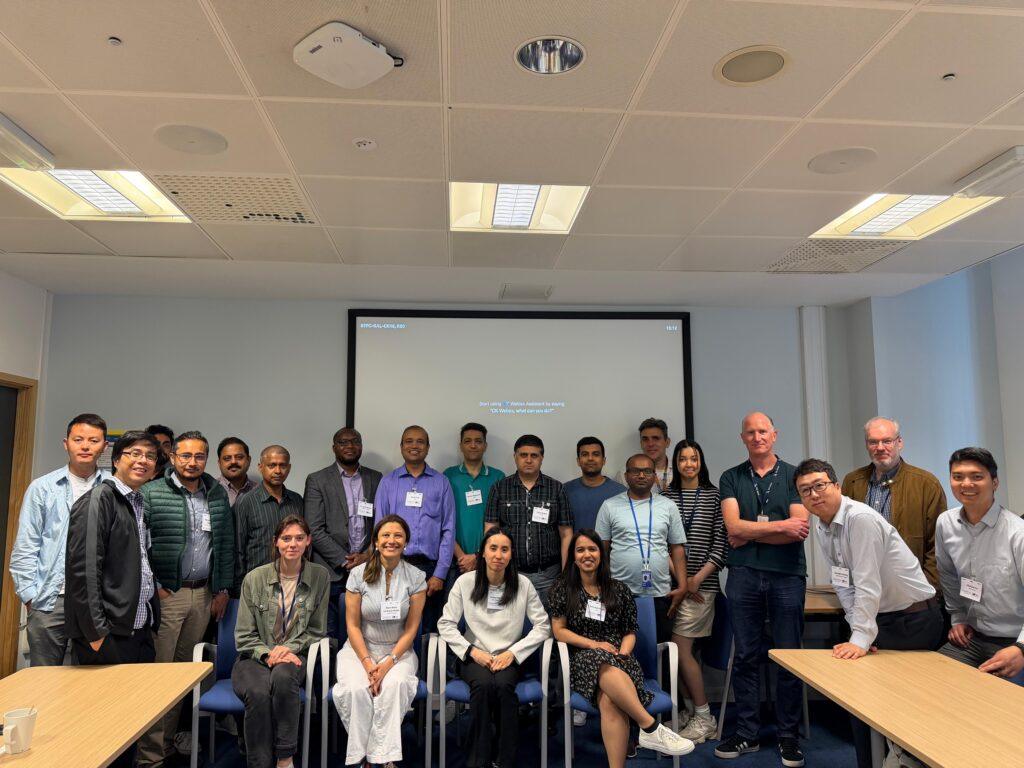
The event was organised by the University of the West of England (UWE Bristol) and designed to provide participants with practical exposure to national HPC infrastructure while exploring how advanced computing capabilities can support research, innovation, and decision-making across a range of application domains.
The workshop addressed one of the key challenges identified through the project’s stakeholder engagement activities: the gap between awareness of HPC capabilities and their practical adoption by researchers and practitioners. Many organisations recognise the potential benefits of HPC but face challenges relating to accessibility, skills, confidence, infrastructure awareness, and integration into existing workflows.
The day began with an introduction to HPC concepts and an overview of DAFNI’s role as the UK’s national platform for infrastructure modelling, simulation, and data analytics. Participants were introduced to DAFNI’s architecture, including its secure data repositories, modelling services, workflow management capabilities, visualisation tools, and Kubernetes-based computational infrastructure. Examples of current applications demonstrated how HPC enables research in climate resilience, infrastructure interdependencies, flood risk assessment, transport systems, digital twins, and resilience modelling.
The programme also highlighted how DAFNI facilitates collaboration between academia, industry, and government through secure environments that enable the sharing of data, models, and computational workflows. Participants explored case studies including climate resilience demonstrators, infrastructure resilience modelling, and digital twin applications supporting national infrastructure planning and management.
A major feature of the event was the facility tour, which provided participants with direct access to the HPC and data infrastructure supporting DAFNI and JASMIN. The visit enabled attendees to observe the scale of computational resources required to support advanced modelling and data-intensive research while gaining insights into the operational and technical considerations associated with managing national research infrastructure.
Beyond technical training, the event created opportunities for dialogue between researchers, practitioners, and infrastructure providers. Discussions focused on challenges and opportunities associated with HPC adoption, including skills development, user support, accessibility, interoperability, governance, and pathways for increasing engagement among underrepresented user communities.
The workshop aligns closely with the objectives of NFCS NetworkPlus, which seeks to develop more inclusive and accessible future computational infrastructure. By exposing participants to real-world HPC environments and fostering collaboration across disciplinary and sectoral boundaries, the event contributed to building awareness, confidence, and capacity among current and prospective HPC users.
Dr Tariq Umar, Principal Investigator of the project, said:
Our project is focused on understanding how future computational infrastructure can be designed around user needs rather than purely technical requirements. The DAFNI and JASMIN visit provided an invaluable opportunity for participants to see these facilities in action, engage directly with experts, and better understand how HPC can support innovation within their own research and professional contexts.
The insights gained from the workshop will inform the project’s ongoing development of an evidence-based roadmap for inclusive HPC adoption. Findings from the project will contribute to recommendations aimed at improving accessibility, usability, engagement, and long-term sustainability of future computational infrastructure across the UK research and innovation landscape.
For further information about the project, upcoming activities, or opportunities for collaboration, please contact the Project Lead, Dr Tariq Umar. The project team welcomes enquiries from researchers, industry professionals, policymakers, and other stakeholders interested in advancing inclusive and accessible high-performance computing infrastructure across the environment, health, and built environment sectors.