
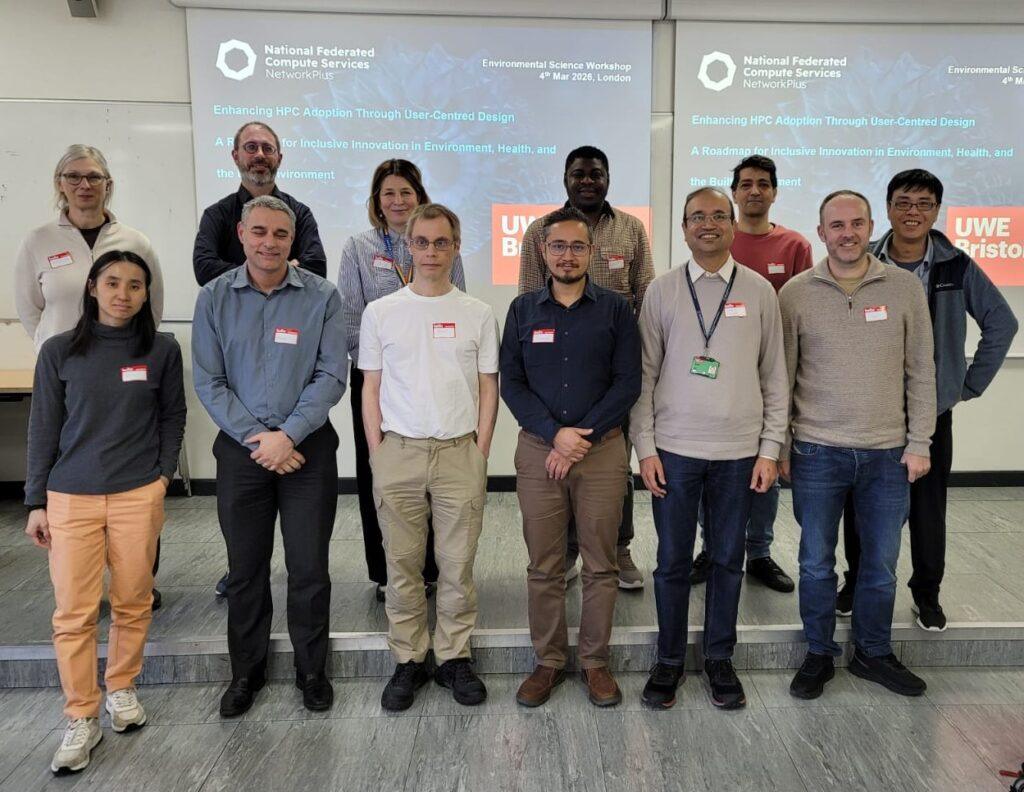
Researchers, digital infrastructure specialists, and environmental scientists gathered at Imperial College London on the 4th of March 2026 for a collaborative workshop exploring how high-performance computing (HPC) can better support environmental research through inclusive, transparent, and user-centred infrastructure design.
The workshop, titled “Enhancing HPC Adoption Through User-Centred Design: A Roadmap for Inclusive Innovation in Environment, Health, and the Built Environment,” was organised as part of the NFCS Network+ initiative and brought together experts from universities, national research facilities, and digital research infrastructure programmes.
Exploring Barriers to HPC Adoption
A key focus of the workshop was identifying barriers that researchers face when attempting to use HPC systems for environmental research. Participants discussed challenges related to data access, software compatibility, skills gaps, and complex workflows, which can delay projects and limit wider adoption of advanced computational tools.
Discussions highlighted that while HPC has enormous potential to transform environmental modelling, digital twins, and large-scale simulation, many researchers struggle with practical issues such as:
- Accessing national HPC facilities
- Installing and maintaining specialised scientific software
- Integrating workflows across multiple computing environments
- Managing large datasets and storage limitations
Participants emphasised that these barriers are particularly significant for early-career researchers, smaller institutions, and interdisciplinary teams.
Building Trust and Transparency in Shared HPC Systems
The workshop also explored how trust, transparency, and governance should be embedded in shared or federated HPC infrastructures.
As research increasingly relies on collaborative digital platforms, participants discussed concerns related to data privacy, governance, accountability, and responsibility for shared datasets and models. Questions were raised about who is responsible when issues arise, such as data breaches or misuse of shared computational resources.
Participants highlighted the importance of designing HPC systems that support transparent workflows, explainable modelling processes, and responsible data management, particularly when working with sensitive environmental or societal datasets.
Guest Speakers Share Experience of HPC in Environmental Research
The workshop featured presentations from leading researchers and digital infrastructure experts who shared their experiences using HPC in environmental science.
Speakers highlighted how HPC enables researchers to simulate complex systems such as river basins, climate processes, and urban environmental systems, often involving large datasets and computationally intensive models. The discussions also explored how different computing infrastructures—including national supercomputing facilities, cloud platforms, and specialised data analysis systems—are increasingly being integrated to support complex environmental research workflows.
Participants also discussed the evolving landscape of UK digital research infrastructure, including facilities such as ARCHER2, JASMIN, and emerging AI-focused supercomputing resources, which are expected to play a key role in supporting data-intensive environmental science.
Towards an Inclusive HPC Future
A central theme of the workshop was the need for more inclusive and accessible HPC systems.
Participants envisioned a future where researchers can access computing resources seamlessly through a single digital identity, with HPC allocations integrated into research funding systems. Such an approach could reduce administrative barriers and make advanced computational resources more accessible across disciplines.
The workshop also highlighted the importance of:
- Better training and onboarding for new HPC users
- Strong technical support and research software engineering expertise
- Simplified access to national computing infrastructure
- Improved collaboration between domain scientists and computational specialists
Participants emphasised that developing an inclusive HPC ecosystem is essential for enabling researchers across academia, industry, and policy to address complex environmental challenges.
Informing the NFCS Roadmap
Insights gathered during the workshop will contribute to the development of a national roadmap for inclusive and federated HPC infrastructure, helping ensure that digital research systems support diverse research communities.
To further support capacity building in this area, a training event and HPC facility visit is planned for May 2026. The event will provide researchers with practical insights into national HPC facilities, hands-on learning opportunities, and guidance on how to effectively use advanced computational resources in environmental and interdisciplinary research.
Researchers interested in attending the training and facility visit are encouraged to contact the Project Lead, Dr Tariq Umar, at tariq.umar@uwe.ac.uk for further information.